A plastic storage bin can look right in a sample photograph and still be the wrong purchase. Lids may stop fitting when samples from different cartons are mixed. Nested containers may be difficult to separate. A low unit price may come with bulky packaging that increases freight costs.
For retailers, importers and distributors sourcing household storage containers, a useful comparison starts with the specification, the packed carton and the acceptance checks—not the price alone. This checklist explains what to clarify before approving samples or placing a bulk order.
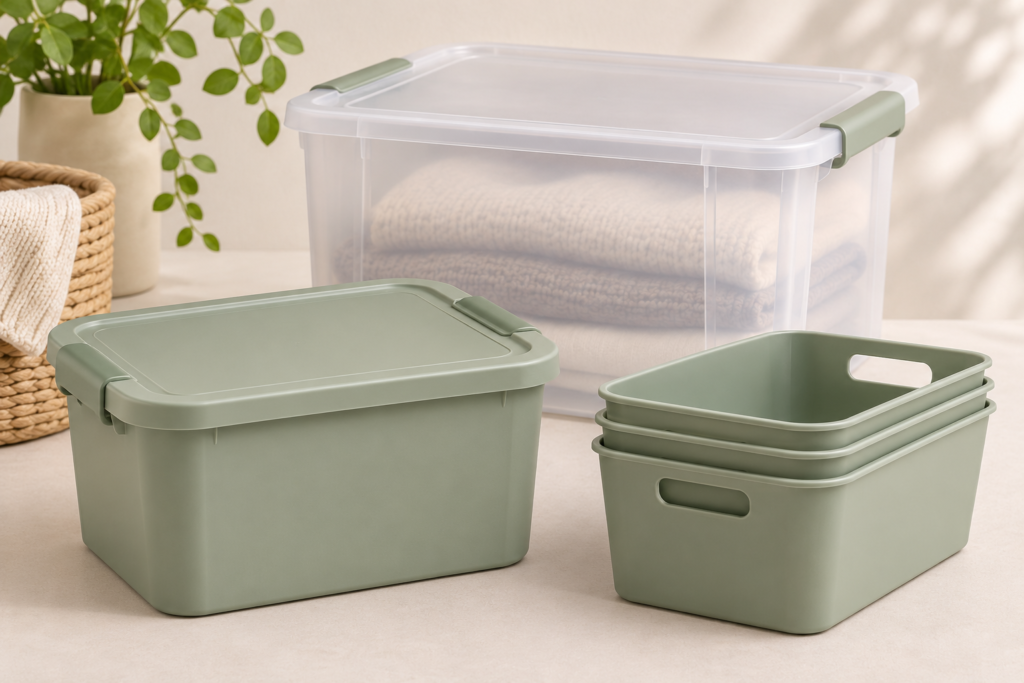
Featured image: AI-generated product illustration, not a supplier photograph or stock catalogue.
1. Define the storage bin before requesting a quotation
“Plastic storage box with lid, 20 litres” leaves too many purchasing decisions unresolved. Two products with the same stated capacity may have different footprints, usable internal space, lid mechanisms and packaging requirements.
- Intended use: wardrobe organization, utility-room storage or general household organization. Do not assume food-contact suitability from appearance.
- Dimensions: external length, width and height, including the lid and handles, plus the internal dimensions that matter to the customer.
- Capacity: how the claimed volume is measured and whether it represents practical usable space.
- Material: the specified resin, such as polypropylene (PP), colour, transparency and any agreed recycled-content requirement, supported by relevant evidence.
- Construction: product weight, handle design, lid type and expected working load. Weight alone does not establish strength.
- Retail configuration: individual units or sets, labels, barcodes, packaging and carton quantities.
Include agreed tolerances and reference samples. If the supplier proposes another material or construction, request a revised specification and sample rather than treating the change as equivalent automatically.
2. Check lid fit, stacking and nesting separately
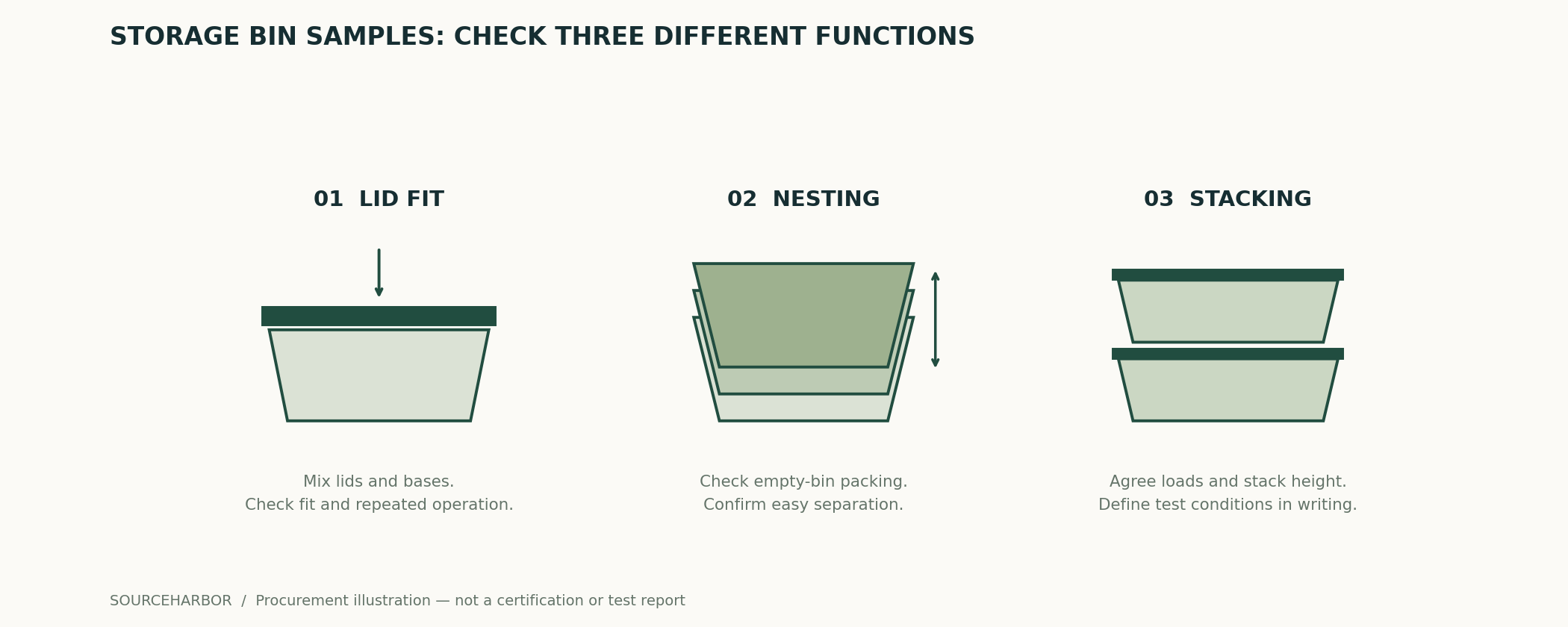
These features solve different problems. Stackable storage bins should sit securely in the intended loaded configuration. Nestable containers fit inside one another when empty to reduce storage or shipping space. A product can do one well and the other poorly.
Ask for several samples, not just one display unit. Mix lids and bases across the samples to check interchangeability. Open and close the lids, operate handles or clips, and inspect for distortion and sharp edges. Confirm that nested bins can be separated without excessive force.
For stacking, agree the intended load, stack height, test conditions and acceptance criteria before testing. A short tabletop demonstration cannot establish every warehouse, transport or consumer-use condition. Include the packed retail configuration in sample review, because a label or shrink-wrap arrangement may change how products nest.
3. Compare carton volume before comparing bulk prices
Plastic storage containers are bulky relative to their value. The number of units per export carton and the way lids are packed can materially change the cost per sellable unit.
Request confirmed outer carton dimensions, gross weight, units per carton and packing photographs. Calculate carton volume in cubic metres (CBM): length × width × height, with all three measurements in metres. Then divide by the number of sellable units inside.
Worked example: the cheaper bin is not always the cheaper shipment
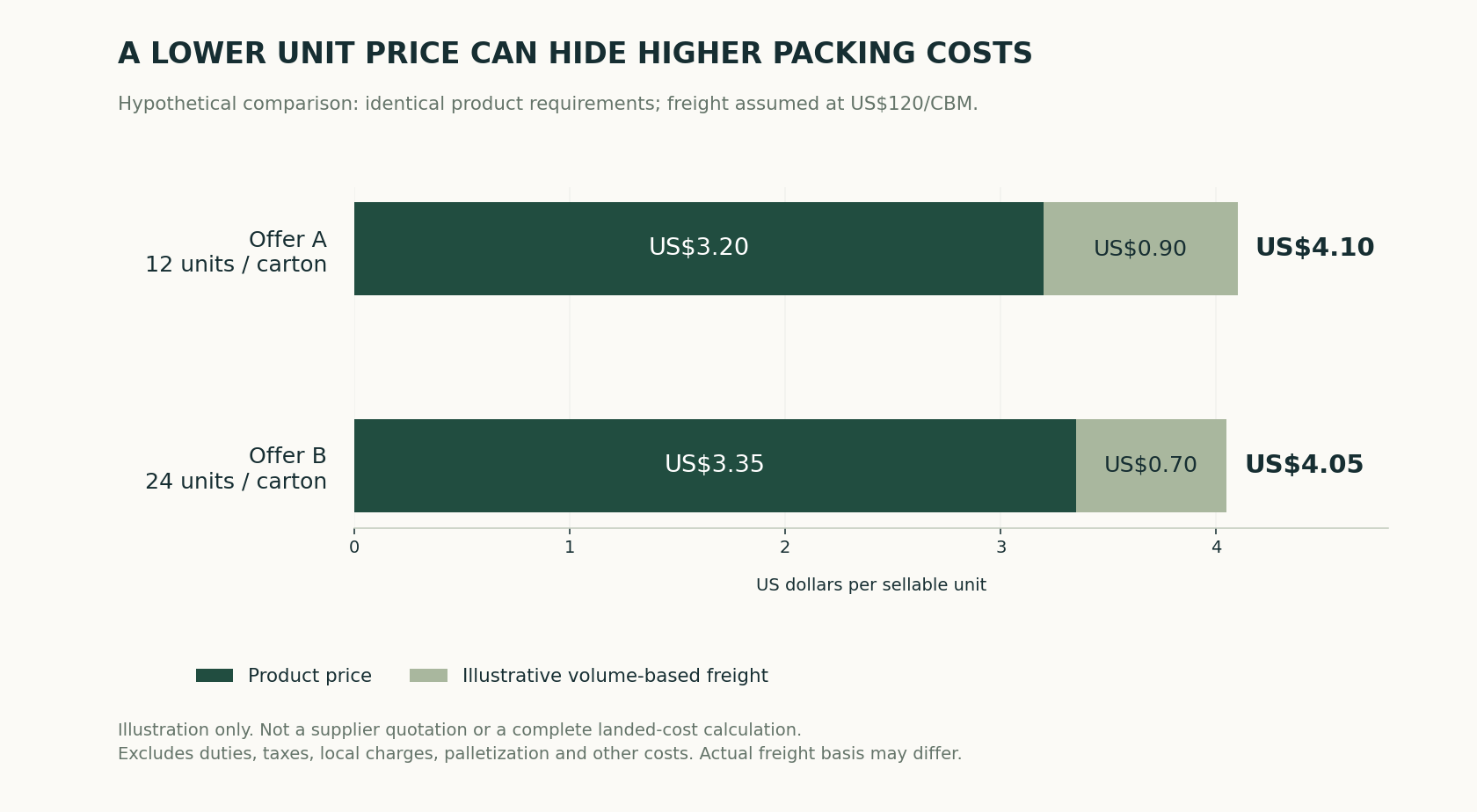
The figures below are hypothetical purchasing assumptions, not supplier quotations or current freight rates. Both offers are assumed to meet the same specification and use the same pricing basis.
| Comparison item | Offer A | Offer B |
|---|---|---|
| Product price per unit | US$3.20 | US$3.35 |
| Units per carton | 12 | 24 |
| Carton volume | 0.090 CBM | 0.140 CBM |
| Volume per unit | 0.00750 CBM | 0.00583 CBM |
| Illustrative volume-based freight at US$120/CBM | US$0.90/unit | US$0.70/unit |
| Product + this freight component | US$4.10/unit | US$4.05/unit |
For 6,000 units, the assumed packing uses 45 CBM for Offer A and 35 CBM for Offer B. In this simplified example, Offer B costs US$0.15 more at product level but US$0.05 less after the illustrated freight component.
This is not a complete landed-cost calculation. Duties, taxes, insurance, origin and destination charges, palletization, loadability, minimum freight charges and damage are excluded. Actual freight charging may depend on weight, volume or container rates. Check the real packing plan and delivery terms with your logistics provider.
4. Link the approved sample to production checks
A signed-off sample is useful only when the approval identifies what was accepted. Record the model, dimensions, material specification, colour reference, product weight tolerance, lid or clip operation and packaging version. Keep a dated reference and a written list of approved changes.
Agree how production samples will be selected, which defects matter and what happens when a check fails. Practical checks may include dimensions, appearance, fit, sharp edges, handle operation, carton counts and barcode matching. Functional, transport or specialist tests need their own agreed methods and conditions.
Do not accept “airtight,” “heavy duty,” “food safe” or “recycled” as self-explanatory claims. Define the intended claim and request evidence relevant to the actual product and destination market. SourceHarbor can discuss sampling and quality inspection coordination as part of an agreed engagement.
5. Send suppliers the same RFQ checklist
When requesting wholesale storage bin quotations, ask every candidate to answer the same questions:
- Which model and specification does the quotation cover?
- What are the minimum quantities per size, colour and packaging version?
- Are samples, tooling, printing, labels and packaging included or charged separately?
- How many sellable units fit in each carton, and what are its confirmed dimensions and gross weight?
- How are bins and lids nested or packed, and is the quoted arrangement the approved retail configuration?
- What starts the lead-time clock: deposit, artwork approval or sample approval?
- What quality checks, documentation and issue-resolution steps are agreed?
- What are the payment terms, delivery basis and quotation validity?
For sourcing in Malaysia, Thailand or Vietnam, apply a consistent brief across candidates. Country alone does not establish quality, cost or suitability; compare evidence for the specific product and supplier.
Questions buyers ask before ordering storage containers
Is a heavier plastic storage bin always stronger?
No. Material formulation, geometry, wall distribution, handles and manufacturing consistency also matter. Compare agreed functional checks, not weight alone.
Should storage bins be shipped with lids attached?
It depends on product protection, nesting efficiency and retail presentation. Review the actual packed sample and carton dimensions for each arrangement before approving it.
What should a buyer send to a sourcing partner?
Send specifications or reference drawings, quantities per SKU, packaging needs, destination market, required delivery timing and any unresolved supplier questions. Clear requirements make a supplier shortlist and quotation comparison more useful.
Planning your next household storage range?
SourceHarbor supports household product sourcing and supplier management in Malaysia, Thailand and Vietnam. Share your storage bin specifications, expected quantities and packaging requirements so we can discuss an appropriate scope for supplier sourcing, quotation coordination and order follow-up.